Home / The Edits / Investment Pieces
The Ballet Flat Is Not a Trend
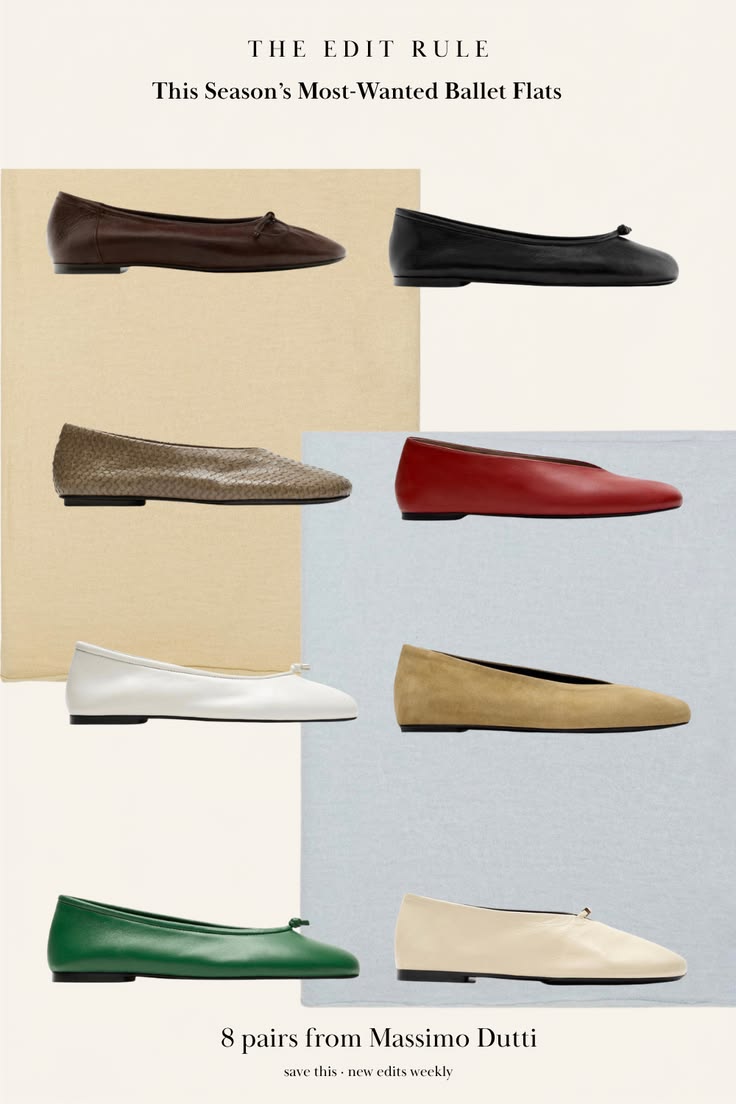
Every few years the ballet flat is announced as back, which is a strange thing to say about a shoe that has been quietly in production since the 1950s. It did not go anywhere. It simply stopped being photographed for a while.
That distinction matters if you are deciding whether to buy a pair. A trend is something you wear until it stops being interesting. A returning classic is something you buy once and keep. Ballet flats outfit ideas are everywhere at the moment, but the question worth asking is not whether to get involved. It is which pair survives the moment.
The shape decides everything
Colour is what people choose on. Shape is what determines whether the shoe gets worn.
The vamp. This is the height of the front, where the shoe meets the top of your foot. A low vamp shows more of the instep and lengthens the leg. A high vamp cuts across the foot and shortens it. Nearly every complaint about ballet flats making legs look stumpy is a complaint about vamp height, not about the shoe.
The toe. A square or softly squared toe reads current and gives the toes room. A sharply pointed flat borrows from the court shoe and behaves like one, which means it flatters the leg line and punishes the foot. A round toe is the safest and the least interesting.
The sole. Look for a sole with a visible edge rather than one that disappears. That thin dark line at the base of the shoe is what stops a flat looking like a slipper, and it is the single detail that separates the expensive-looking pairs from the rest.
Which colour first
The eight pairs in this edit run from black through brown, taupe, red, green, white, tan suede and cream. They do not all do the same job.
In this edit
Black disappears. Under a trouser hem it reads as nothing at all, which is exactly what you want from a shoe that is not meant to be the point. It works with tights through winter, and it is the version formal enough for an office where a trainer would not pass.
Chocolate brown warms everything around it. Against camel, cream and khaki it does something black cannot: it belongs to the same family rather than interrupting it. In a wardrobe built on warm neutrals this is the pair that makes an outfit look assembled rather than assorted.
Red behaves as an accent, not a statement. It works the way a red belt or a red bag works: one point of colour in an otherwise quiet outfit. It is more wearable than it sounds, because a shoe sits at the furthest point from the face and cannot dominate a room the way a red coat can.
Woven and suede are texture rather than colour. Both do something useful in an outfit that is otherwise flat: linen trousers, a cotton shirt, plain denim. They are also the two that suffer most in British weather, which is a real consideration rather than a stylistic one.
White and cream are summer shoes and should be understood as such. They look beautiful for one season and then look tired, because a pale flat shows every mark and cannot be properly cleaned.
The comfort conversation
Ballet flats have a reputation for being comfortable that is only partly deserved, and it is worth being honest about.
A flat with no arch support, worn on pavement for eight hours, will hurt. The shoe is soft, the ground is not, and there is nothing between them. This is not a fault in any particular pair, it is what a flat is.
What makes the difference is a leather sole with some structure rather than a glued-on rubber pancake, and a footbed that is at least lightly padded. A thin insole added afterwards helps considerably and costs very little.
The other honest note: leather ballet flats stretch. Buy them snug rather than comfortable, because the pair that fits perfectly in the shop will be loose at the heel within a month.
Three ways to wear them
With straight-leg jeans. The hem should sit at or just above the ankle bone, showing the top of the shoe. A jean covering the whole shoe turns the flat into a slipper.
With a midi skirt. This is the combination that needs the low vamp most, because the leg is already broken at the calf. A high vamp here shortens twice and neither cut is forgiving.
With tailored trousers, cropped. The most underused of the three, and the one that makes a flat look like a work shoe rather than a weekend one. Works particularly well in black or chocolate.
Why they keep coming back
It is worth understanding why this particular shoe returns every few years, because it explains what to expect from it.
The ballet flat solves a problem that does not go away: how to be flat without being sporty. A trainer reads as casual whatever it is worn with. A loafer reads as slightly formal. The flat sits between the two and takes on the register of whatever is above it, which is why the same pair works with jeans on Saturday and tailoring on Tuesday.
That neutrality is also the reason it disappears from fashion coverage periodically. There is very little to say about it. A shoe with no story is difficult to photograph twice, and easy to forget until someone points at it again.
For a wardrobe built on pieces that work more than one way, a shoe with no story is close to ideal.
Caring for them
Ballet flats live a harder life than most shoes because there is so little of them.
Protect suede before the first wear, not after the first mark. Suede that has been sprayed survives a wet pavement. Suede that has not, does not, and there is no recovering it.
Rotate them. A leather flat worn daily has no chance to dry out, and the lining breaks down at the heel first. Every other day roughly doubles the life of a pair.
Replace the insole rather than the shoe. When a flat starts to feel thin underfoot, the footbed has compressed long before the outsole has worn. A cheap replacement insole restores most of what was lost.
Keep them stuffed. A ballet flat left empty collapses at the vamp, and that crease is permanent. Tissue paper is enough, shoe trees are better.
What to check before buying
Bend the shoe. It should flex at the ball of the foot and nowhere else. A flat that folds in half has no structure and will lose its shape within weeks.
Check the heel counter. Press the back of the shoe with your thumb. If it collapses entirely, the heel will slip and no amount of wearing in will fix it.
Try both feet at the end of the day. This applies to all shoes and especially to flats, where there is no adjustment mechanism at all.
Where it sits in a capsule
The seven-shoe list on this site already includes a flat, and the ballet flat is the version of it that works hardest. It crosses from jeans to a skirt to tailoring without changing register, which is more than can be said for a trainer or a court shoe.
Black and chocolate are the two that ask least of the rest of the wardrobe. The other six are for wardrobes with a clearer palette to build against, which is a matter of what you already own rather than what you should acquire next.
Save this edit
Pin it to your board so it is there the next time you are standing in front of the wardrobe.
Save to Pinterest