The Khaki Edit: This Season's Neutral, Styled Head to Toe
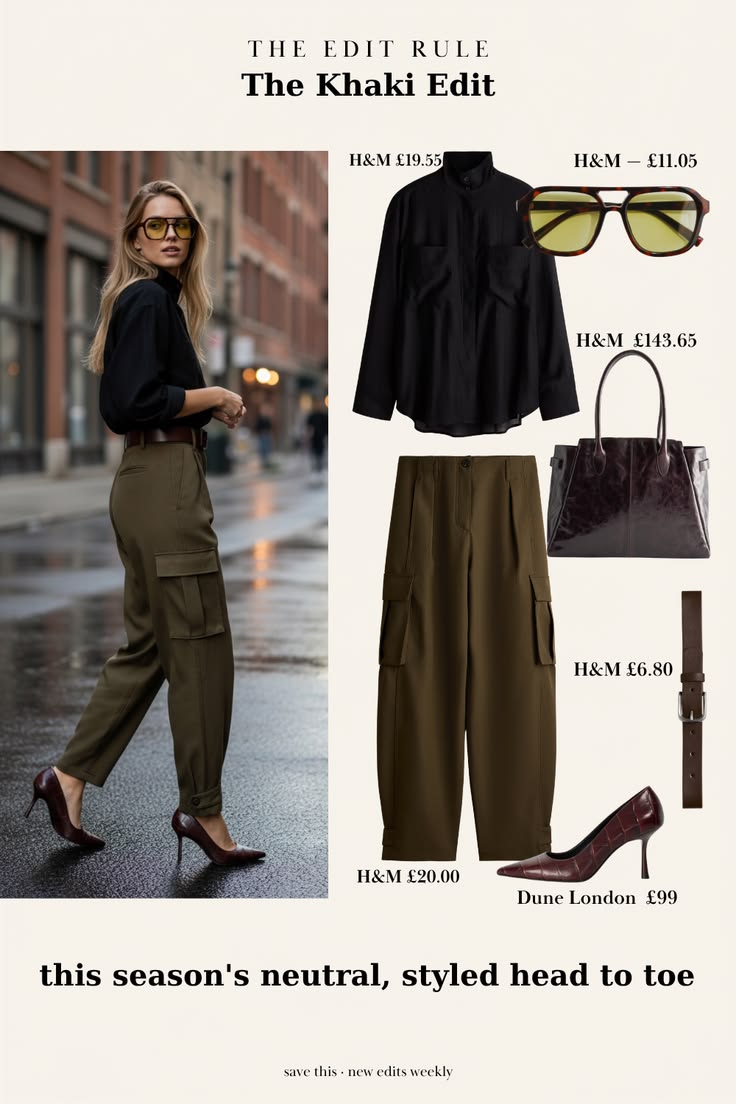
Prices were correct at the time of writing.
Most people file khaki under colour rather than neutral, which is why it sits at the back of the wardrobe getting worn twice a year. It is treated like a decision, and decisions are what a good wardrobe removes.
But a khaki trousers outfit behaves exactly the way a navy or charcoal one does. It takes black, brown, cream and burgundy without argument. It reads as considered rather than casual. The only thing separating it from the neutrals people already trust is familiarity.
Here is the version worth copying, and the four decisions holding it together.
Why khaki counts as a neutral
A neutral is not a colour with no character. It is a colour that does not fight anything else in the outfit.
Khaki qualifies because it sits between brown and green, which means it agrees with both families. Warm browns look intentional against it. Black grounds it. Cream lifts it. Burgundy, which is the interesting one, reads almost as an accent colour without ever becoming loud.
What khaki does not do well is sit next to another mid-tone green or a cool grey. Those are the two combinations to avoid, and they are the reason people conclude khaki is difficult when it is not.
The trouser shape does most of the work
The pair here is a cargo, and the cargo detail is the part that could go wrong. Pockets on the thigh add volume exactly where most people do not want it.
The version that works has the pockets sitting flat rather than gathered, and a leg that tapers slightly at the ankle. That taper is what stops a wide khaki trouser reading as workwear in the literal sense. Cuffed once, as in the photograph, it shortens the line just enough to keep a heel visible.
A high waist matters here more than usual. Cargo pockets sitting low on the hip pull the whole silhouette down. Sitting at the natural waist, they land closer to the narrowest part of the leg and disappear.
Black on top, and why not navy
The shirt is black, and that is a deliberate choice rather than a default.
Navy against khaki produces two mid-tones competing for the same job, and neither wins. Black is far enough away in depth that it reads as a clean stop. It also does something useful with the trouser: khaki looks warmer next to black than it does next to anything else, which is what keeps it from tipping into military.
The shirt is loose and tucked, not fitted. A fitted black top against a full trouser makes the proportion top-light. The volume needs to be roughly matched on both halves, with the waist marking where one ends.
The burgundy is the whole trick
Look at the outfit again and the thing making it feel designed is not the khaki. It is the burgundy appearing twice: once at the shoe, once at the bag.
Burgundy against khaki is an old pairing and it works because the two are near-opposites in temperature but similar in depth. Neither is brighter than the other, so nothing shouts. It is the same logic as a tan shoe with navy, one step more interesting.
Repeating it twice is what turns it from an accident into a decision. One burgundy item reads as whatever was nearest the door. Two, spaced apart, reads as intent.
The belt is brown rather than burgundy, and that is correct. Three burgundy items would tip the balance and start to look matched, which is a different and worse effect.
The six pieces
In this edit
Three ways to wear the trouser
The outfit above is the polished version. The trouser has two more settings, and both use pieces most wardrobes already hold.
Softened. Swap the black shirt for a cream knit and the court shoe for a loafer. The burgundy leaves entirely and the outfit becomes warm-neutral throughout: khaki, cream, brown. This is the version for a day with no meetings in it, and it is the one that will get worn most.
Sharpened. Add a black blazer over the black shirt and keep the heel. The cargo pocket stops being the focus and the trouser reads almost as tailoring. Worth knowing if your office sits on the formal side, because it is the only version of a cargo trouser that survives a boardroom.
Weekend. White trainers, a plain white t-shirt, no belt, trouser uncuffed. The proportion changes completely because the ankle is covered and the waist is unmarked. It looks like a different trouser, which is precisely the argument for buying it.
Three settings from one piece is the threshold this site uses for anything entering a wardrobe. The khaki cargo clears it comfortably, which is more than can be said for most trend trousers.
A note on the tote
The bag is the most expensive item here by a distance, and it is worth saying why it is in the edit rather than quietly leaving it out.
Burgundy leather in a structured shape is doing two jobs: it repeats the shoe, and it gives the outfit its only piece of real texture. Everything else is flat. Without it the combination is correct but slightly airless.
If it is not the piece you want, the substitution is any structured bag in a dark warm tone. What does not work is black, which flattens the burgundy at the shoe into an accident, or tan, which pulls too close to the khaki.
What to check before buying khaki
Khaki varies more between retailers than almost any other neutral, and the photograph on a website is not reliable.
Check it in daylight. Shop lighting is warm and pushes khaki towards brown. In daylight the same trouser can read distinctly green, which changes what it works with. If you are buying online, hold the delivered item next to a window before removing the tags.
Check it against your existing brown. If your bag, belt and shoes are already a specific brown, the khaki either sits with it or fights it. There is no middle ground and no styling fix.
Check the fabric weight. A thin khaki twill creases across the lap within an hour of sitting and never quite recovers. This is the fabric where paying attention to weight matters most, because the colour shows every fold.
How it fits a capsule
The trouser is the piece that earns its place. It goes with everything a charcoal trouser goes with, and additionally with the browns and creams a charcoal one struggles against.
The black shirt is already in most wardrobes. The belt and sunglasses are small enough to be adjustments rather than additions. Which leaves the burgundy shoe as the only genuinely new decision, and that pair works well beyond this outfit: against navy, against cream, against denim.
That is the test worth applying to any seasonal edit. Not whether the outfit works, but how many of its pieces survive the season it was bought for.
Save this edit
Pin it to your board so it is there the next time you are standing in front of the wardrobe.
Save to Pinterest