What Actually Fits Under a London Desk
Some links in this article are affiliate links, which means we may earn a commission at no extra cost to you.
The gym membership costs forty pounds a month and gets used in January. The evening walk works until the clocks change and it is dark at four. By February most people who intended to move more are moving less than they did in September, and the reason is almost never willpower.
It is logistics. A walking pad in a small flat solves a logistics problem, not a fitness one, and that distinction matters because it changes what you should be looking for.
The honest case for one
A walking pad is not a treadmill and it is not trying to be. There is no incline, no running, usually no handrail. It does one thing: it lets you walk at three or four kilometres an hour while doing something else.
That sounds trivial. In practice, on a day with four back-to-back calls where you would otherwise not leave the chair between eight and six, an hour of slow walking spread across the day is the difference between a sedentary day and an ordinary one.
The version of this that fails is the one bought as a replacement for exercise. The version that works is the one bought as a replacement for sitting still.
Measure before you buy anything
Four measurements, and it is worth taking them properly before looking at any products.
Desk clearance. Measure floor to underside of desk. Then subtract the height of the pad, which is usually between 10 and 15cm. Then subtract your own height, standing. If the result puts your head near the ceiling of a low-ceilinged flat, or your knees near the desk, the setup does not work regardless of what the pad costs.
Walking surface length. The belt, not the machine. Anything under 100cm is uncomfortable for anyone above average height at anything above a slow pace.
Storage footprint. The dimension that actually decides whether it gets used. Measure the gap it will live in when folded or stood on its end: beside a wardrobe, under a bed, behind a door. If there is no such gap, it will live permanently in the middle of the room, and in a one-bedroom flat that is how a walking pad becomes a clothes horse within a month.
The doorway and the stairs. These things are heavy. Check the delivered weight against the route into the flat, particularly if there is a narrow Victorian staircase involved, which in London there very often is.
The question nobody asks: the neighbours
If you live in a flat with someone below you, this is the consideration that decides whether the purchase works.
Walking pads transmit impact through the floor. On a concrete floor this is a non-issue. On the suspended timber floors in most converted London flats, it is very much an issue, and it is the single most common reason these get sold on within six months.
Two things help. A dense rubber mat underneath, not a thin yoga mat, which is the simplest fix and makes a real difference. And restricting use to daytime hours, which for a home worker is usually when you would use it anyway.
If you are on a timber floor with a neighbour below, buy the mat at the same time as the pad rather than after the first complaint.
What to look for
A quiet motor above anything else. The specification to look at is decibels at working speed. This matters twice over: for the neighbours, and because a loud motor makes it unusable during calls, which is when you were going to use it.
Speed range starting genuinely low. A pad that starts at 2km/h is more useful for desk walking than one starting at 4km/h. The slow end is where the actual use happens.
A remote or a phone app. Reaching down to a control panel while typing is the small friction that stops it getting used.
Weight capacity with headroom. Buy above your weight, not at it. Motors run under less strain and last longer.
Where to look
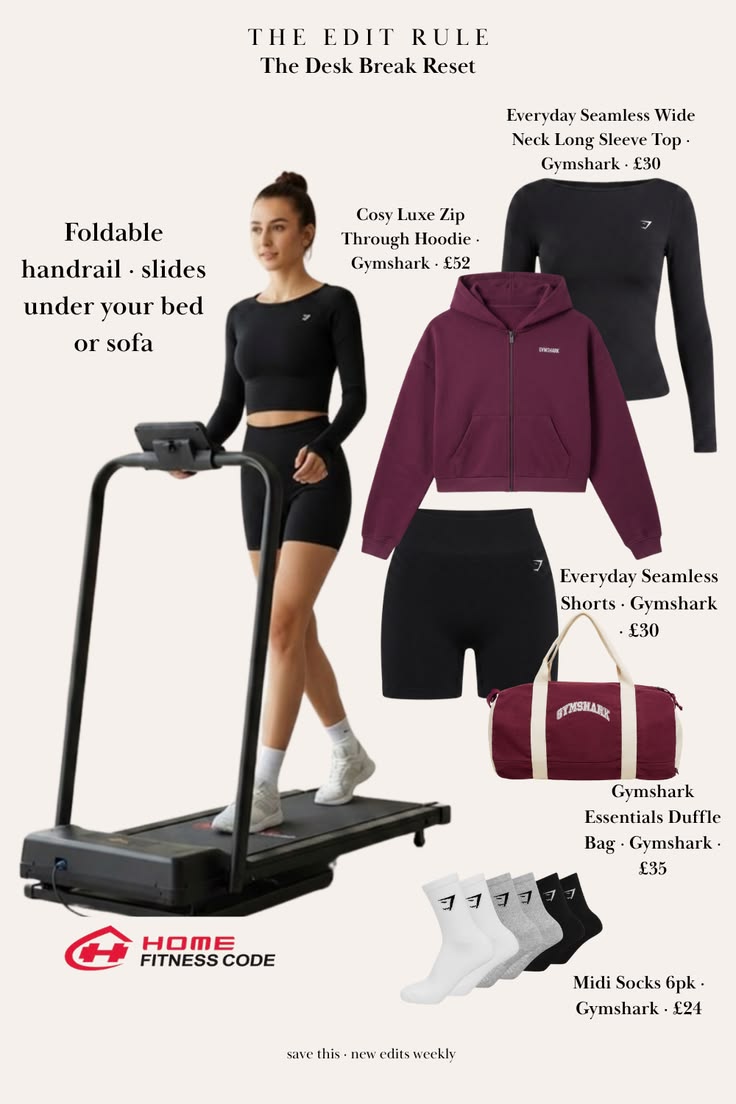
Home Fitness Code is a UK retailer, which matters more than it sounds for something this heavy: delivery, returns and warranty are all considerably simpler than ordering a 30kg item from overseas.
Setting it up so it gets used
The pad is the easy part. The setup around it decides whether it survives past week three.
Leave it out if you possibly can. The single biggest predictor of use is whether it needs unfolding first. If it lives under the bed, it will be used on the days you already felt like it, which are not the days that matter.
Sort the desk first. Walking at a desk set for sitting means typing with your arms too low, and that becomes a shoulder problem within a fortnight. A standing desk converter is the cheap version of this fix.
Shoes on. Walking barefoot or in socks on a moving belt for an hour a day is how people acquire foot pain and then blame the pad. A pair of trainers kept beside it solves it.
Start at twenty minutes. Not two hours. The failure mode is doing too much on day one, aching on day two, and never returning.
What a realistic week looks like
The fantasy is four hours a day at a walking desk. The reality, for almost everyone who keeps one past the first month, is considerably less and considerably more sustainable.
A workable pattern: two or three sessions of twenty to forty minutes, attached to things that were happening anyway. The morning call that does not need you on camera. The afternoon slump at three, which is when sitting is least productive regardless. A podcast at the end of the day instead of the walk that is not happening because it is dark.
That comes to something between one and two hours on a working-from-home day, at a pace slow enough that you can type and talk normally. It is not exercise in the way a run is. It is the removal of eight hours of stillness, and the two are not the same thing.
What does not work: trying to walk during focused work. Anything requiring real concentration suffers, and after a week of noticing that, the pad stops getting used. Attach it to the low-concentration parts of the day and it survives.
The things people sell theirs over
Worth knowing before buying rather than after, because these are the recurring reasons secondhand walking pads appear.
Noise, and the neighbour. Covered above, and it is the most common one by a distance.
It lives in the way. In a one-bedroom flat, an object that cannot be stored becomes furniture, and furniture that is not wanted becomes a source of low-level irritation.
The desk was never sorted. Walking at a sitting-height desk causes shoulder and wrist problems within weeks, and the pad gets blamed for a setup problem.
Bought for running. A walking pad is not a treadmill. If the intention was to run, this is the wrong object and no amount of use will make it the right one.
Three of those four are solvable before purchase, which is the argument for measuring and thinking rather than ordering on a January impulse.
Whether it is worth it
It depends entirely on one thing: whether you work from home enough for it to be used on a weekday.
If you are in an office five days a week, this is a weekend object and a weekend object gets used the way a weekend gym membership does. If you work from home two or more days, it changes those days genuinely, and the arithmetic against a gym membership works out inside a year. The folding models are the ones worth looking at first.
Everything else, the specification, the brand, the price bracket, matters far less than that single question.
Save this edit
Pin it to your board so it is there the next time you are standing in front of the wardrobe.
Save to Pinterest