Neutrals Have a Temperature, and Autumn Is the Warm One
Most wardrobes treat neutral as a single category. Black, white, grey, navy, and whatever beige arrived by accident. It works, it is easy, and by the third week of September it starts to look slightly cold.
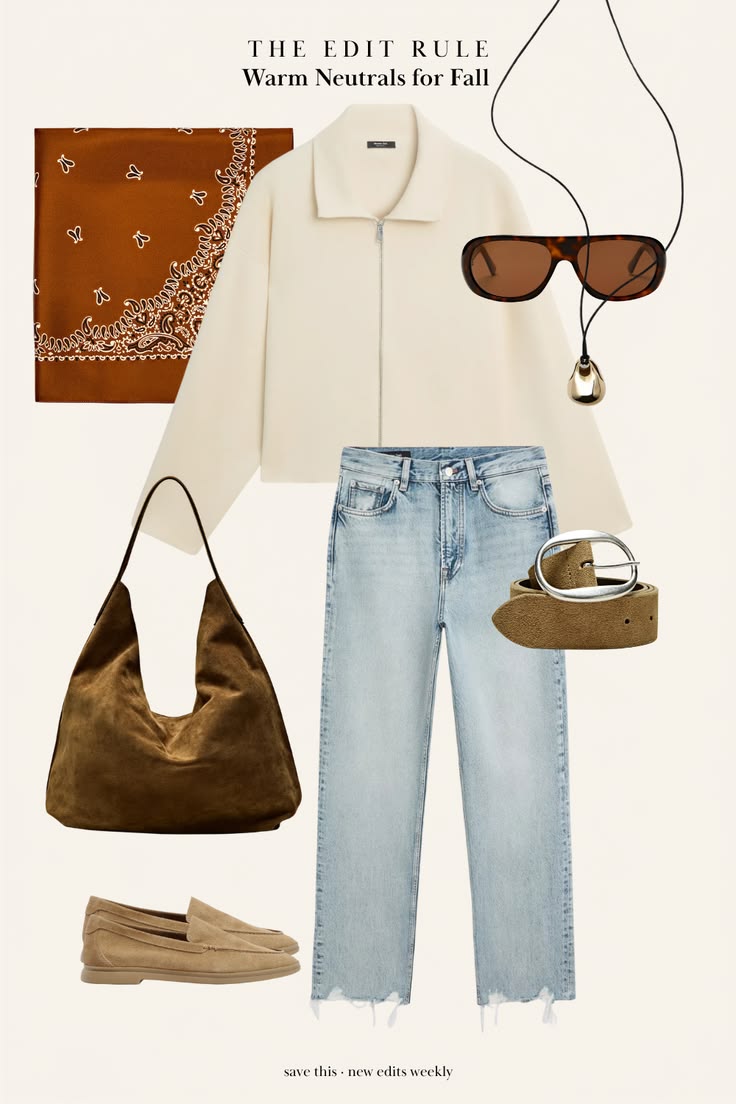
The warm neutral autumn outfit is the other half of that category, and it is the half that suits the season. Cream instead of white. Camel and tan instead of grey. Brown instead of black. The outfit here is a cream zip-up jacket, light wash jeans, a brown suede shoulder bag and beige loafers, with a burnt orange bandana scarf at the neck.
Five neutrals, no contrast to speak of, and it still reads as a considered outfit rather than a beige blur. The reason is undertone.
Save this edit
Pin it to your board so it is there the next time you are standing in front of the wardrobe.
Save to PinterestWhat undertone actually means
Every neutral leans somewhere. Cream leans yellow, white leans blue. Camel leans orange, grey leans nowhere. Chocolate brown leans red, black leans black.
When every piece in an outfit leans the same way, the eye stops registering them as separate colours and starts reading the whole thing as one surface with texture on it. That is the effect people describe as expensive, and it has very little to do with what anything cost.
Mixing temperatures is not a mistake, and plenty of good outfits do it deliberately. But it takes more decisions. Staying inside one temperature takes none, which is why this is a useful thing to know on a Tuesday morning.
Why cream and not white
A white jacket in October looks like a leftover from August. Cream does not, and the difference is a small amount of yellow.
Cream also does something practical for most people. It puts a soft, slightly warm surface next to the face at the time of year when daylight is going blue and flat. White under a grey London sky can drain a complexion. Cream tends not to.
The tradeoff is that cream shows everything. It wants a fabric with some weight and a tight weave, and it wants cleaning more often than you would like.
Light wash denim is the surprise
The instinct in autumn is to reach for dark denim, because dark reads as more serious. But dark indigo is a cool blue, and against cream and camel it sits slightly apart from everything else.
Light wash is warmer. It has gone soft and slightly sandy, which puts it much closer to the tan and beige in the rest of the outfit. That is why the outfit holds together despite denim usually being the odd piece out.
Straight or wide leg both work. What matters more is that the wash is even, without heavy fading down the thigh, since that draws a bright vertical line through the middle of an outfit that is otherwise very calm.
In this edit
Suede is doing more than it looks
The bag is the piece that stops this being flat.
Cream cotton, denim and smooth leather are all fairly matte and fairly even. Suede is neither. It catches light differently depending on which way the nap is sitting, so it reads as a slightly different shade from every angle.
In an outfit built on one temperature, that variation is what replaces contrast. Take the suede out and swap in a smooth tan leather bag and the whole thing goes noticeably quieter, in a way that is hard to name until you see them side by side.
Suede has a real cost in a British autumn, which is rain. A protector spray genuinely helps, and it is worth doing before the first wear rather than after the first accident.
The scarf is not a pop of colour
Burnt orange sounds like an accent, and in most outfits it would be. Here it is not doing that job.
Burnt orange is what you get when you take the camel and tan already in the outfit and turn up the saturation. It is the same family, louder. So it does not interrupt the outfit, it concentrates it.
This is the difference between an accent and an anchor. A true accent, a cobalt or a red, would sit apart from everything and pull the eye to the neck. The bandana instead tells you what colour the whole outfit is, from the one place you are most likely to look.
If burnt orange is not yours, the same logic holds for rust, brick, ochre and tobacco. What matters is that it is a saturated version of what is already there, not a departure from it.
Loafers, and the case against a boot
A boot is the obvious autumn shoe and it would not be wrong here. But a beige loafer does something a boot cannot, which is to keep the leg line uninterrupted.
Because the loafer is close in tone to the denim and the jacket, the eye runs from shoulder to floor without stopping. A dark boot puts a full stop at the ankle. On a shorter frame in particular, that full stop costs visible height.
The loafer also keeps the outfit from tipping into a costume version of autumn. Cream jacket, scarf, suede bag and boots together start to look like a seasonal outfit assembled on purpose. The flat shoe undercuts it just enough to read as something you own rather than something you planned.
Where this outfit sits in the week
This is a weekend outfit, or an office with no dress code, or the kind of day that starts at a desk and ends somewhere that is not one.
It does not go to a formal meeting, and the reason is the denim rather than anything else. Swap the jeans for a camel or chocolate trouser in the same weight and the outfit moves up a register without losing the palette. Everything else stays exactly where it is.
For colder weeks it takes a chocolate brown coat over the top. Not a black one, which would sit outside the temperature and undo the effect the whole outfit is built on.
Building it from what you own
You probably have more of this than you expect. Light wash denim, a tan or brown bag, and a flat shoe in some shade of beige are all common.
The two pieces that decide whether it works are the cream layer and the scarf. Cream is the one worth being particular about, because a cream that leans grey rather than yellow will fight everything else. Hold it against something you know is warm, a camel coat or a tan bag, and it will be obvious within a second which way it leans.
The scarf is the cheapest way into the whole idea. If you want to test whether warm neutrals suit you before committing to a jacket, tie a rust or ochre square at the neck of something you already wear and see what happens to your face in the mirror.