The Waistcoat Is Doing the Blazer's Job Now
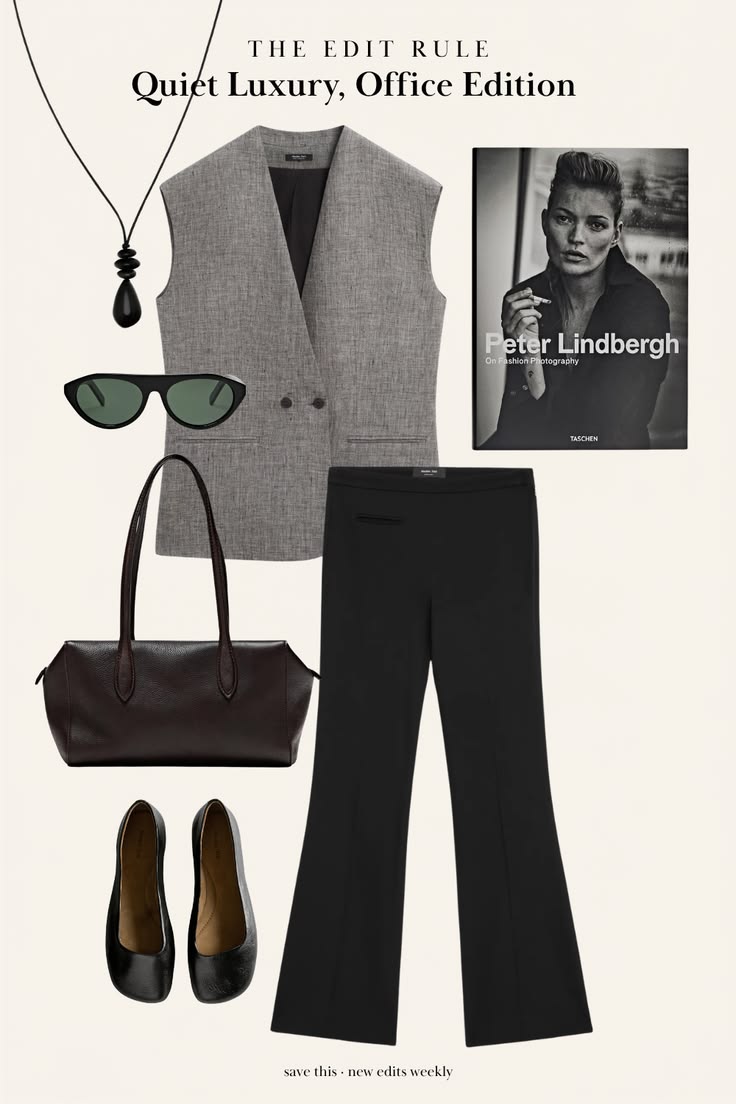
There is a particular kind of office outfit that reads as expensive without announcing anything. No logo, no print, no colour doing the heavy lifting. Just a good shoulder line, a long clean trouser and one piece of gold jewellery that stays on all day.
The phrase attached to it is quiet luxury, which has become a slightly tired label for something that is genuinely useful: dressing so that the cut carries the outfit instead of the detail.
This look is a tailored grey double-breasted waistcoat, black flare trousers, a structured leather tote and black ballet flats. Five things. It works because of what it leaves out.
Save this edit
Pin it to your board so it is there the next time you are standing in front of the wardrobe.
Save to PinterestWhy the waistcoat replaced the blazer
A blazer solves a shoulder problem and creates a temperature problem. In a London office in late August, with the heating still off and the air conditioning aggressive by the window, a full jacket is either too much or removed within twenty minutes. Once it comes off the outfit underneath has to hold on its own, and usually it does not.
A double-breasted waistcoat gives you the same vertical line and the same structured shoulder without the sleeves. It stays on. That is most of the argument.
It also changes what the arms are doing. A sleeveless tailored piece exposes the shirt or the bare arm, which reads as more relaxed than a blazer while the torso stays as sharp. The outfit ends up looking considered rather than corporate.
What makes a waistcoat sit properly
The difference between a waistcoat that looks tailored and one that looks like a costume piece comes down to three things.
The armhole. Cut too low and the whole thing gapes when you reach for something. A high, close armhole is what keeps it clean when you move, and it is the first thing to check in the mirror with your arms raised.
The length. It should finish at or just below the waistband, so there is no gap of shirt showing between the hem and the trouser. A waistcoat that stops short cuts the body in half at the widest point.
The button placement. Double-breasted means the buttons sit wide, which broadens the chest and narrows everything below by contrast. It is the same trick a double-breasted coat plays, at a shorter length.
Grey is the useful neutral here
Black waistcoat with black trousers is one solid column, which is elegant but flat. Grey against black gives you a break at the waist and a bit of light near the face, without introducing a colour anyone will remember.
Mid grey in particular sits between the two things a workwear neutral has to do. It is quiet enough to disappear in a meeting and warm enough not to drain the face under fluorescent light, which very cold grey does.
If you are building this and grey is not in your wardrobe, taupe and stone behave the same way. The point is contrast against the trouser, not the specific shade.
The flare trouser is the balance
A waistcoat narrows the top half. Something has to answer that at the bottom or the proportion tips.
A black flare does it by widening gradually from the knee, which lengthens the leg and stops the outfit looking top-heavy. The width sits below the eye line, so it reads as elegance rather than volume.
Two things make or break it. The hem should almost touch the floor with the shoe you plan to wear, because a flare that stops at the ankle loses the whole line. And the fabric needs enough weight to fall straight instead of clinging, which is what separates a tailored flare from a jersey one.
In this edit
Flats, not heels, and it still reads formal
The instinct with a flare is a heel, because the hem needs the height. But a floor-length flare hides the shoe almost entirely, so the height is doing less work than you think.
A black ballet flat under a black flare disappears into the trouser and reads as one continuous line to the floor. You get the lengthening effect without the walk to the station being a negotiation.
This is the second time this month a flat has quietly solved a formal outfit, which is not a coincidence. The flat has stopped being the compromise option.
The accessories are doing precise work
Three pieces, each with a job.
The structured tote holds the shape of the outfit. A slouchy bag against tailoring undoes the line, so a bag with a flat base and a defined edge matters more here than in a casual look. It also has to take a laptop, which is a separate problem worth its own edit.
The gold is simple and singular. One necklace, nothing that swings or catches the light as you move. Statement jewellery competes with the waistcoat's buttons and the outfit stops being quiet.
The green-tinted sunglasses are the one deliberate oddity. Everything else is grey, black and gold, so a soft tint at the face is the only thing in the outfit that is a choice rather than a rule. Without it, the look is correct but slightly cold.
Where this outfit actually goes
It suits a day with more than one register in it. A morning of internal meetings, a client thing at two, drinks afterwards that you did not fully plan for.
The waistcoat is the reason it holds across all three. It is formal enough for the client meeting and relaxed enough at six that you do not look like you came straight from a desk. There is no layer to remove and nothing to swap out.
For a colder version, the same five pieces take a long wool coat over the top and the proportion still works, because the waistcoat adds no bulk at the shoulder.
Building it from what you own
Most of this is already in a working wardrobe. The trouser, the tote, the flat and the jewellery are standard.
The waistcoat is usually the missing piece, and it is worth being specific about the fit rather than the label. Try it with your arms raised, check the hem against your waistband, and see whether the buttons sit wide enough to broaden the chest. A well-cut one from anywhere will beat a badly cut one from a good name.
Everything else is restraint. The outfit works because nothing in it is trying to be the thing you notice.